




ORGANS OF PARIS © 2026 Vincent Hildebrandt HOME ALL ORGANS



C2
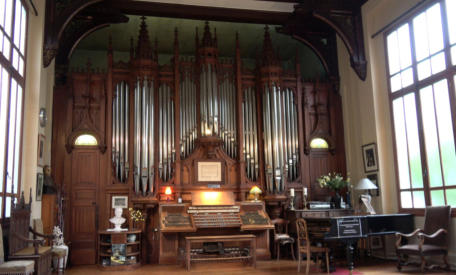
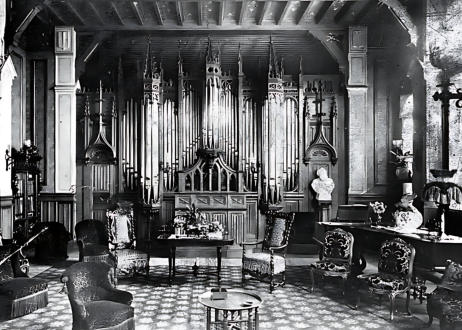
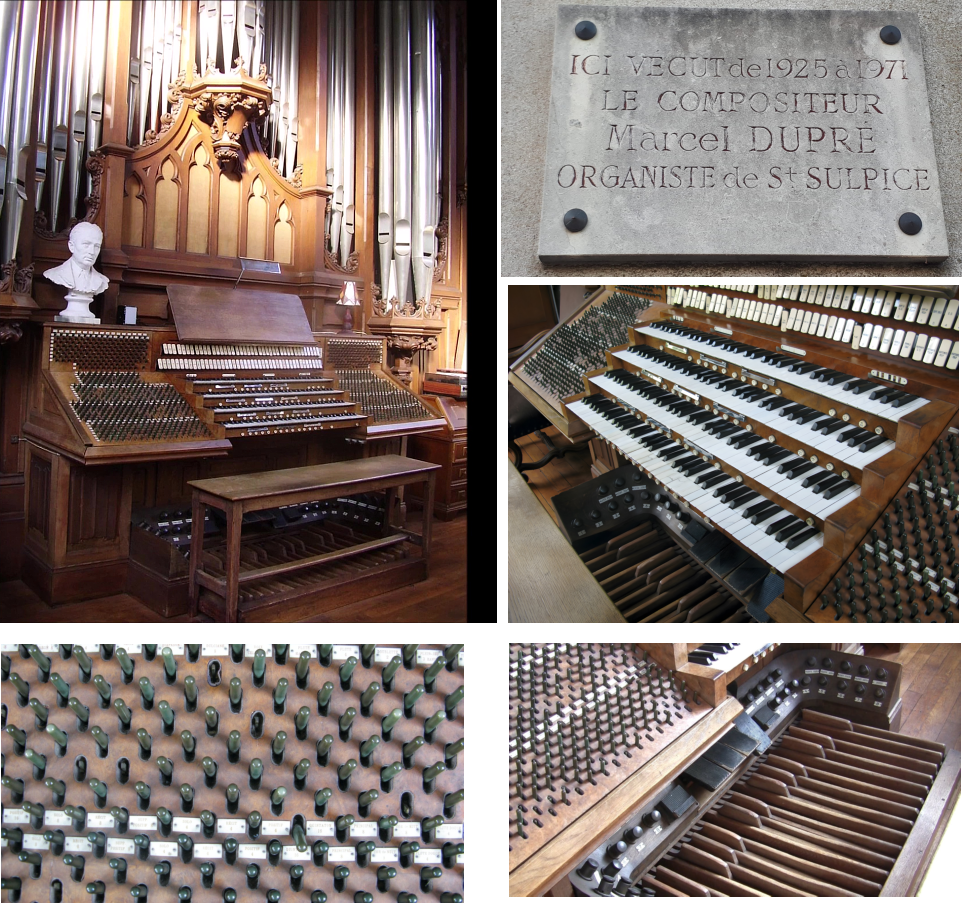
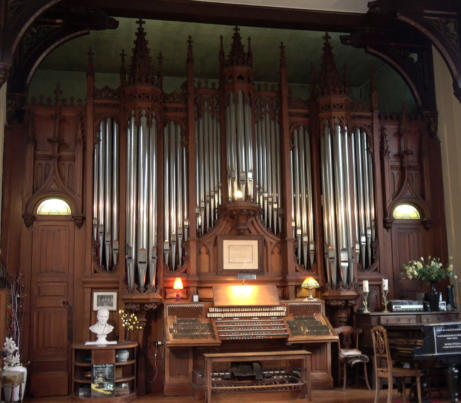
The Marcel DUPRE auditorium is located in Meudon, in
the house of the Master (built in 1860) who lived there
from 1925 to 1971. Dupré had a music room added
where he installed the organ built in 1899 by Charles
Mutin for Alexandre Guilmant and installed in his house -
now demolished - at 10 chemin de la station in Meudon,
which was renamed in his name after his death. The neo-
Gothic sideboard was designed by the Lille architect
Buisine. The hall, decorated with 19th-century stained-
glass windows, was used by Dupré for private concerts
and became a mecca for music between the two wars.
It originally had three manuals with 28 stops, as follows:
Great organ (61 notes): Bourdon 16', montre 8', flûte
harmonique 8', salicional 8', prestant 4'.
Positif expressif (61 notes): Cor de nuit 8', flûte creuse 8',
viole de gambe 8', flûte douce 4', nazard 2 2/3', quarte de
nazard 2', tierce 1 3/5', cromorne 8'.
Expressive recitative (61 notes): Diapason 8', transverse
flute 8', dulcian 8', celestial voice 8', octave flute 4',
doublet 2', plein-jeu III ranks, harmonic trumpet 8',
bassoon-hautbois 8'.
Pedal (30 notes?): Double bass 16', Bass 16', flute 8',
drone 8', cello 8', bassoon 16'.
Shots. I, II and III, acc. II/I, III/I in 16 and 8, III/II, I in 4,
pedal reed, combination stops (quarter turn) I and III,
extension III, recitative reeds, recitative tremolo.
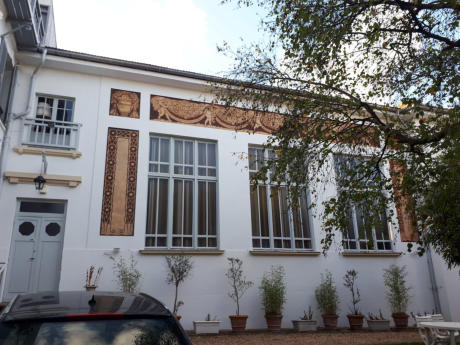
In 1926 Marcel Dupré bought a villa not far from
Guilmant's house at 40 bd Anatole France in Meudon and
acquired his organ, which was installed there by Joseph
Beuchet, then director of Cavaillé-Coll.
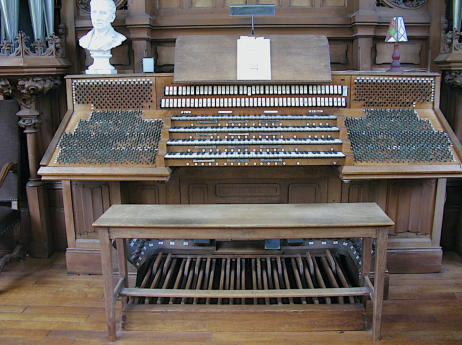
A solo division with 6 stops was added in 1934. The
transmission of the stops was transformed into an
electro-mechanical system to allow the use of the
multiple combinations imagined by Dupré with
sostenuto. The range of the keyboards was extended by
an octave. The rocking combinations give the instrument
a distinctly modernist feel.
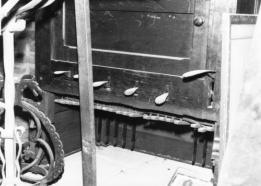
The old console was saved and is currently in possesion
of an organist in Mons (Belgium).
The instrument is used for concerts thanks to
maintenance provided by Mr Jean-Claude Mérouze, and
the Dupré villa in which it is housed was acquired in 1979
by a retired pharmacist who developed a passion for the
organ after selling medicines. Another form of care!
The organ is in good condition, but the acoustics are dry
and the sensitivity of the keyboards requires flawless
technique.
Source & facebook @Aristide Cavaillé-Coll


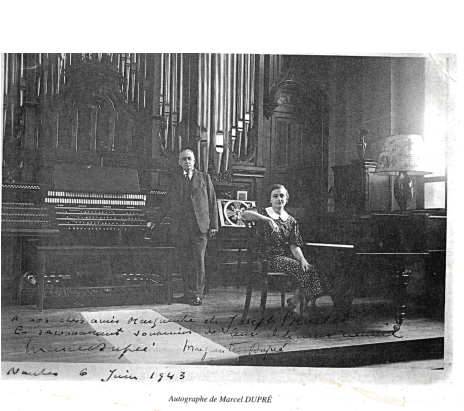
Marcel Dupre and his daughter Marguerite. The dedication is addressed
to the Nantes organ builder Joseph Beuchet.

1899 - Cavaillé-Coll (1)
1926/1934 - Societé Cavaillé-Coll (3a)
1979 - Jean-Claude Merouze (5)
IV/34 - mechanical traction (notes);
electro-pneumatical traction (stops)
Stoplist
Site of the organ
Video of the organ
Video Marcel Dupré-1
Video Marcel Dupré-2
Video improvisation Marcel Dupré -1
Video improvisation Marcel Dupré -2
Video Frédéric Blanc (improvisation)
Audio Françoise Renet

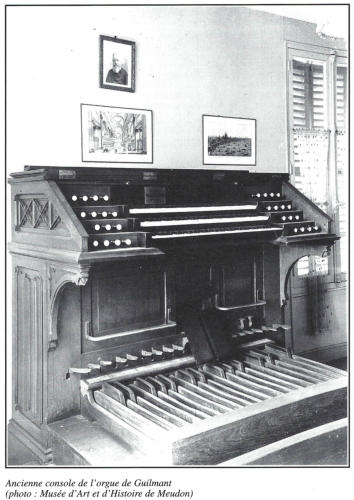
The old console of Cavaillé-Coll
When
Dupré
had
the
instrument
modernized
in
1934,
the
old
Cavaillé-
Coll
console
was
placed
in
the
garden
pavilion.
The
Dupré
heirs
later
gave
this
console
to
R.
Falcinelli.
After
a
few
years,
due
to
lack
of
space,
she
attempted
to
offer
it
to
the
regional
conservatory
in
Meudon,
but
without
success.
She
then
turned
to
the
local
museum;
although
the
institution
initially
showed
interest,
it
soon
made
clear
that
it
no
longer
had
room
for
either
the
console
or
Dupré’s
private
archive.
When
the
organ
teacher
at
the
Conservatory
in
Mons
heard
about
this,
he
travelled
to
Meudon
and
was
thus
able,
with
Falcinelli’s
consent,
to
secure
the
console.
(source: Patrick Roose, facebook 2024)








Organs of Paris


ORGANS OF PARIS © 2026 Vincent Hildebrandt
C2
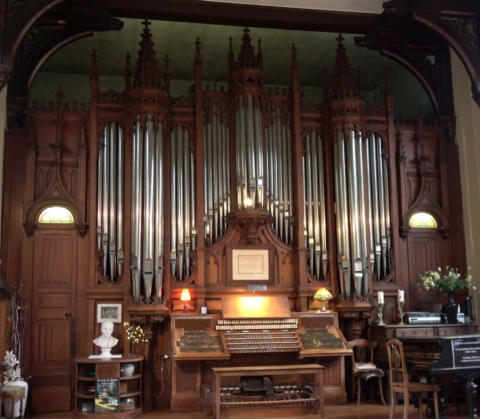
The Marcel DUPRE auditorium is located in Meudon, in the
house of the Master (built in 1860) who lived there from 1925
to 1971. Dupré had a music room added where he installed the
organ built in 1899 by Charles Mutin for Alexandre Guilmant
and installed in his house - now demolished - at 10 chemin de
la station in Meudon, which was renamed in his name after his
death. The neo-Gothic sideboard was designed by the Lille
architect Buisine. The hall, decorated with 19th-century
stained-glass windows, was used by Dupré for private concerts
and became a mecca for music between the two wars.
It originally had three manuals with 28 stops, as follows: Great
organ (61 notes): Bourdon 16', montre 8', flûte harmonique 8',
salicional 8', prestant 4'.
Positif expressif (61 notes): Cor de nuit 8', flûte creuse 8', viole
de gambe 8', flûte douce 4', nazard 2 2/3', quarte de nazard 2',
tierce 1 3/5', cromorne 8'.
Expressive recitative (61 notes): Diapason 8', transverse flute 8',
dulcian 8', celestial voice 8', octave flute 4', doublet 2', plein-jeu
III ranks, harmonic trumpet 8', bassoon-hautbois 8'.
Pedal (30 notes?): Double bass 16', Bass 16', flute 8', drone 8',
cello 8', bassoon 16'.
Shots. I, II and III, acc. II/I, III/I in 16 and 8, III/II, I in 4, pedal reed,
combination stops (quarter turn) I and III, extension III,
recitative reeds, recitative tremolo.
In 1926 Marcel Dupré bought a villa not far from Guilmant's
house at 40 bd Anatole France in Meudon and acquired his
organ, which was installed there by Joseph Beuchet, then
director of Cavaillé-Coll.
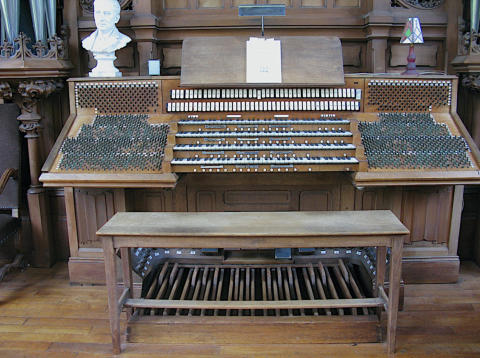
A solo division with 6 stops was added in 1934. The
transmission of the stops was transformed into an electro-
mechanical system to allow the use of the multiple
combinations imagined by Dupré with sostenuto. The range of
the keyboards was extended by an octave. The rocking
combinations give the instrument a distinctly modernist feel.
The old console was saved and is currently in possesion of an
organist in Mons (Belgium).
The instrument is used for concerts thanks to maintenance
provided by Mr Jean-Claude Mérouze, and the Dupré villa in
which it is housed was acquired in 1979 by a retired pharmacist
who developed a passion for the organ after selling medicines.
Another form of care!
The organ is in good condition, but the acoustics are dry and
the sensitivity of the keyboards requires flawless technique.
Source & facebook @Aristide Cavaillé-Coll
1899 - Cavaillé-Coll (1)
1926/1934 - Societé Cavaillé-Coll (3a)
1979 - Jean-Claude Merouze (5)
IV/34 - mechanical traction (notes);
electro-pneumatical traction (stops)
Stoplist
Site of the organ
Video of the organ
Video Marcel Dupré-1
Video Marcel Dupré-2
Video improvisation Marcel Dupré -1
Video improvisation Marcel Dupré -2
Video Frédéric Blanc (improvisation)
Audio Françoise Renet
